
数组与链表
前言#
力扣刷题知识笔记和思路记录
知识点参考:Hello 算法!https://www.hello-algo.com/
一、数组#
(1)280-移动零#
给定一个数组 nums,编写一个函数将所有 0 移动到数组的末尾,同时保持非零元素的相对顺序。
请注意 ,必须在不复制数组的情况下原地对数组进行操作。
示例 1:
输入: nums = [0,1,0,3,12]

输出: [1,3,12,0,0]
示例 2:
输入: nums = [0]

输出: [0]
class Solution(object):
def moveZeroes(self, nums):
"""
:type nums: List[int]
:rtype: None Do not return anything, modify nums in-place instead.
"""
# 自解
pre = 0
cur = 1
while cur < len(nums):
if nums[pre] == 0 and nums[cur] != 0:
nums[pre],nums[cur] = nums[cur],nums[pre]
elif nums[pre] != 0 and nums[cur] == 0:
pre += 1
cur += 1
elif nums[pre] == 0 and nums[cur] == 0:
cur += 1
elif nums[pre] != 0 and nums[cur] != 0:
cur += 1自己的解法思路:
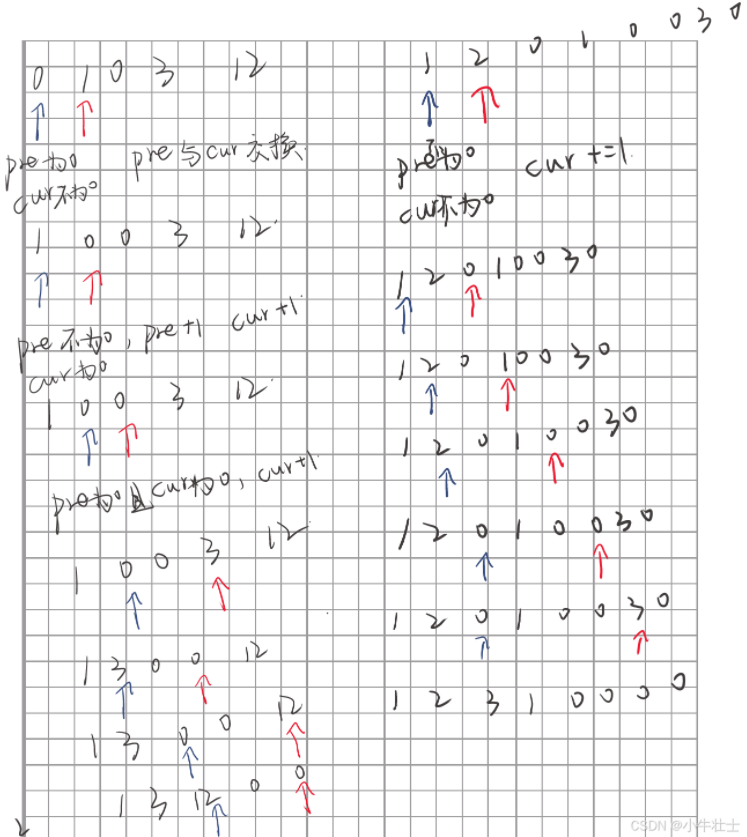
使用两个指针pre和cur,将指针指向数字是否为零将情况分为4类
①pre=0,cur!=0:pre与cur两个数交换位置,将pre的0移动到后面
②pre!=0,cur!=0:cur+1,寻找下一个0
③pre!=0,cur=0:pre+1,cur+1
④pre=0,cur=0:cur+1,寻找下一个非0
总的来说就是移动pre和cur,交换两个数位置
测试结果似乎移动了原来非零数的相对位置
Testcase
[4,2,4,0,0,3,0,5,1,0]Answer
[4,2,4,5,1,3,0,0,0,0]Expected Answer
[4,2,4,3,5,1,0,0,0,0]次优解:
直接利用python列表内置函数,是0的删除,并且在末尾加0
for i in range(len(nums)):
      if nums[i]==0:
          nums.remove(0)
          nums.append(0)
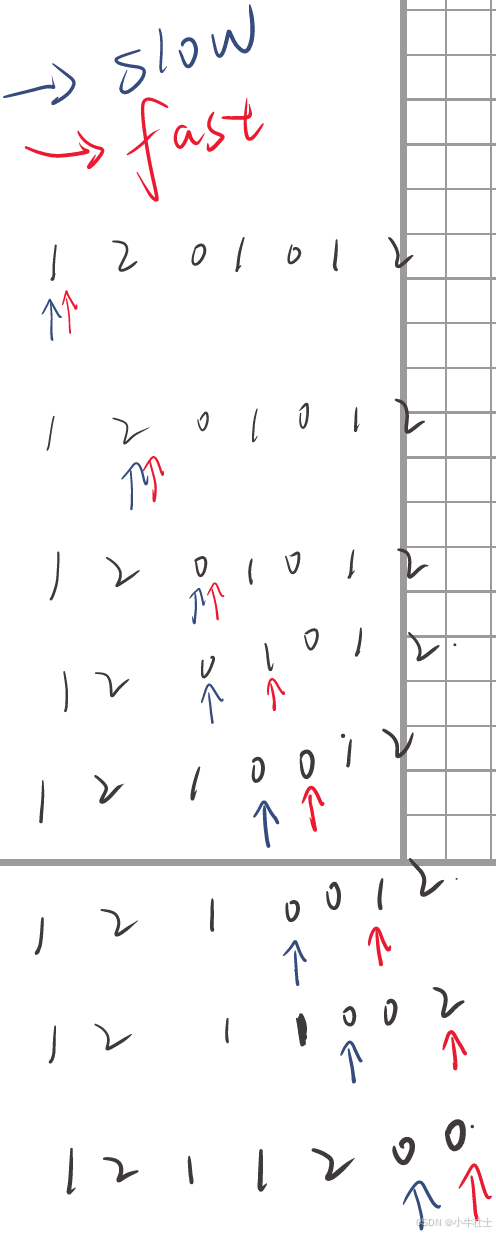
最优解:快慢双指针
        # 最优解
        slow = 0
        for fast in range(len(nums)):
            if nums[fast]!=0:
                nums[fast],nums[slow] = nums[slow],nums[fast]
                slow += 1
(2)566-重塑举证#
在 MATLAB 中,有一个非常有用的函数 reshape ,它可以将一个 m x n 矩阵重塑为另一个大小不同(r x c)的新矩阵,但保留其原始数据。
给你一个由二维数组 mat 表示的 m x n 矩阵,以及两个正整数 r 和 c ,分别表示想要的重构的矩阵的行数和列数。
重构后的矩阵需要将原始矩阵的所有元素以相同的 行遍历顺序 填充。
如果具有给定参数的 reshape 操作是可行且合理的,则输出新的重塑矩阵;否则,输出原始矩阵。
示例 1:
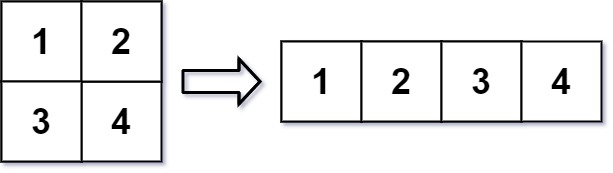
输入:mat = [[1,2],[3,4]], r = 1, c = 4
输出:[[1,2,3,4]]
示例 2:
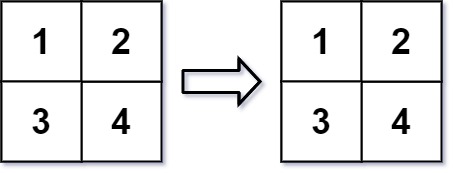
输入:mat = [[1,2],[3,4]], r = 2, c = 4
输出:[[1,2],[3,4]]
思路:
先创建r×c的0矩阵,依次遍历mat,将0变为对应元素
class Solution(object):
    def matrixReshape(self, mat, r, c):
        """
        :type mat: List[List[int]]
        :type r: int
        :type c: int
        :rtype: List[List[int]]
        """
        if r * c != len(mat[0]) * len(mat):
            return mat
        else:
            lst = [[] for i in range(r)]
            for i in lst:
                for _ in range(c):
                    i.append(0)

            r_index = 0
            c_index = 0
            for _ in mat:
                for num in _:
                    print(num)
                    if c_index < c:
                        lst[r_index][c_index] = num
                        c_index += 1
                    else:
                        r_index += 1
                        c_index = 0
                        lst[r_index][c_index] = num
                        c_index += 1
            return lst
方法二:
mat元素索引对
ans[x // c][x % c] = nums[x // n][x % n](3)485-最大连续1的个数
给定一个二进制数组 nums , 计算其中最大连续 1 的个数。
示例 1:
输入:nums = [1,1,0,1,1,1]
输出:3
解释:开头的两位和最后的三位都是连续 1 ,所以最大连续 1 的个数是 3.
示例 2:
输入:nums = [1,0,1,1,0,1]
输出:2
思路:
暴力解法遍历,与最大个数count_max作比较,看是否进行替换
class Solution(object):
    def findMaxConsecutiveOnes(self, nums):
        """
        :type nums: List[int]
        :rtype: int
        """
        count = 0
        count_max = 0
        for i in range(len(nums)):
            if nums[i] == 1:
                count += 1
            if count > count_max:
                    count_max = count
            elif nums[i] ==0:
                count = 0


        return count_max
(3)240-搜索二维矩阵
编写一个高效的算法来搜索 *m* x *n* 矩阵 matrix 中的一个目标值 target 。该矩阵具有以下特性:
- 每行的元素从左到右升序排列。
- 每列的元素从上到下升序排列。
示例 1:
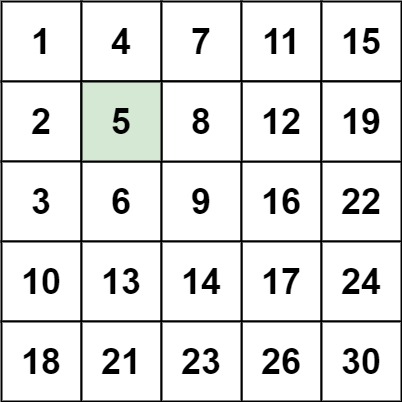
输入:matrix = [[1,4,7,11,15],[2,5,8,12,19],[3,6,9,16,22],[10,13,14,17,24],[18,21,23,26,30]], target = 5
输出:true
示例 2:
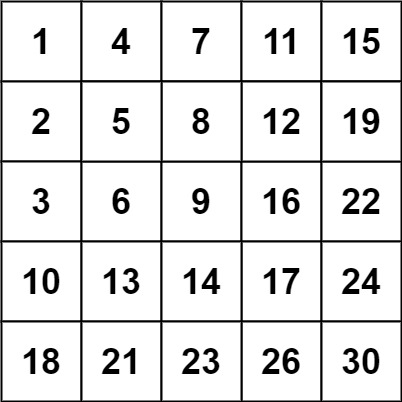
输入:matrix = [[1,4,7,11,15],[2,5,8,12,19],[3,6,9,16,22],[10,13,14,17,24],[18,21,23,26,30]], target = 20
输出:false二、链表#
这里介绍几种形式的链表的增删查改以及列出了题库里面的一些Leetcode例题的解决思路,链表作为一种数据结构,在Leetcode系统上作答是不需要自己去定义节点和链表的类,一般是会在注释中给出定义的提示的,我们只需要按照提示去创建节点就好,为了更好地理解这种算法的优势以及劣势,我们该是需要掌握关于链表的增删查改函数怎么写。
#
# @lc app=leetcode.cn id=160 lang=python
#
# [160] 相交链表
#

# @lc code=start
# Definition for singly-linked list.
# class ListNode(object):
#     def __init__(self, x):
#         self.val = x
#         self.next = None
1. 单向链表#

单向链表就是最简单的一种形态,每个节点属性为自身的值(val)和指向下一节点地址的指针(next),节点通过指针相连成链表
1.1 创建链表容器和节点#
链表相当于一个容器,里面装着节点,节点也可以看成一个容器,在单向链表中,节点里面装着val和next
创建节点:
class Node():

    def __init__(self, val):

        self.val = val

        self.next = None
用类来创建节点,初始化有两个属性,只需要调用这个类就可以形象的创建出节点
创建链表容器:
class SingleLinkList():

    # 这个相当于是一个容器,初始化里面只装着None的头节点

    # 定义头指针

    def __init__(self):

        self._head = None
初始状态下,链表中只装着空值的_head节点,等待传入上面创建的node节点
1.2 创建链表#
第一步:实例化对象创建一个容器
link_list = SingleLinkList()第二步:创建节点,此时只是产生一个节点,并没有加进链表
node1 = Node(100)

node2 = Node(200)
第三步:将节点插入链表中,现在第一个结点是node1
link_list._head = node1将第一个节点node1指向node2
node1.next = node2第四步:访问链表节点数据
第一个节点
print(link_list._head.val)第二个节点
print(link_list._head.next.val)
1.3 单向链表的操作#
这里是直接在链表容器类中添加方法
class SingleLinkList():
    def __init__(self):
        self._head = None

    # 判断是否为空
    def is_empty(self):
        # 直接判断链表容器是不是只有None的头结点
        return self._head is None

    # 链表长度
    def length(self):
        # cur指针指向_head
        cur = self._head
        count = 0
        while cur is not None:
            count += 1
            # cur指针后移
            cur = cur.next
        return count

    # 遍历链表
    def vals(self):
        cur = self._head
        while cur is not None:
            # 生成器生成当前指针节点的val值
            yield cur.val
            cur = cur.next

    # 向链表头部添加元素
    def add(self,val):
        node_add = Node(val)
        node_add.next = self._head
        self._head = node_add

    # 向链表尾部添加元素
    def append(self,val):
        node_append = Node(val)
        if self.is_empty():
            self._head = node_append
        else:
            cur = self._head
            while cur.next is not None:
                cur = cur.next
            cur.next = node_append

      # 插入指定位置
    def insert(self,index,val):
        # 如果指定位置在第一个元素之前,则在头结点插入
        if index <= 0:
            self.add(val)
        # 超过尾节点,则在尾部插入
        elif index > (self.length() - 1):
            self.append(val)
        else:
            node = Node(val)
            cur = self._head
            for _ in range(index-1):
                # 找到要插入的节点
                cur = cur.next
            # 先链接node节点前面箭头
            node.next = cur.next
            # 再链接node节点后面箭头
            cur.next = node


    # 删除指定值的节点
    def remove(self,val):
        #当前节点和前一节点
        cur = self._head
        pre =  None
        while cur is not None:
            if cur.val == val:
                # 如果删除的节点是第一个节点,既没有前节点
                if not pre:
                    self._head = cur.next
                else:
                    # 将删除位置前一个节点的next指向删除位置的后一个节点
                    pre.next = cur.next
                return True
            else:
                # 两个节点依次向后移
                pre = cur
                cur = cur.next

    # 查找元素是否存在
    def find(self,val):
        return val in self.val
链表的增删查改只要是应用了指针的思想,这里拿出节点插入指定位置和删除指定位置节点来做简单分析
1.3.1 节点插入指定位置#
    def insert(self,index,val):
        # 如果指定位置在第一个元素之前,则在头结点插入
        if index <= 0:
            self.add(val)
        # 超过尾节点,则在尾部插入
        elif index > (self.length() - 1):
            self.append(val)
        else:
            node = Node(val)
            cur = self._head
            for _ in range(index-1):
                # 找到要插入的节点
                cur = cur.next
            # 先链接node节点前面箭头
            node.next = cur.next
            # 再链接node节点后面箭头
            cur.next = node
图解:
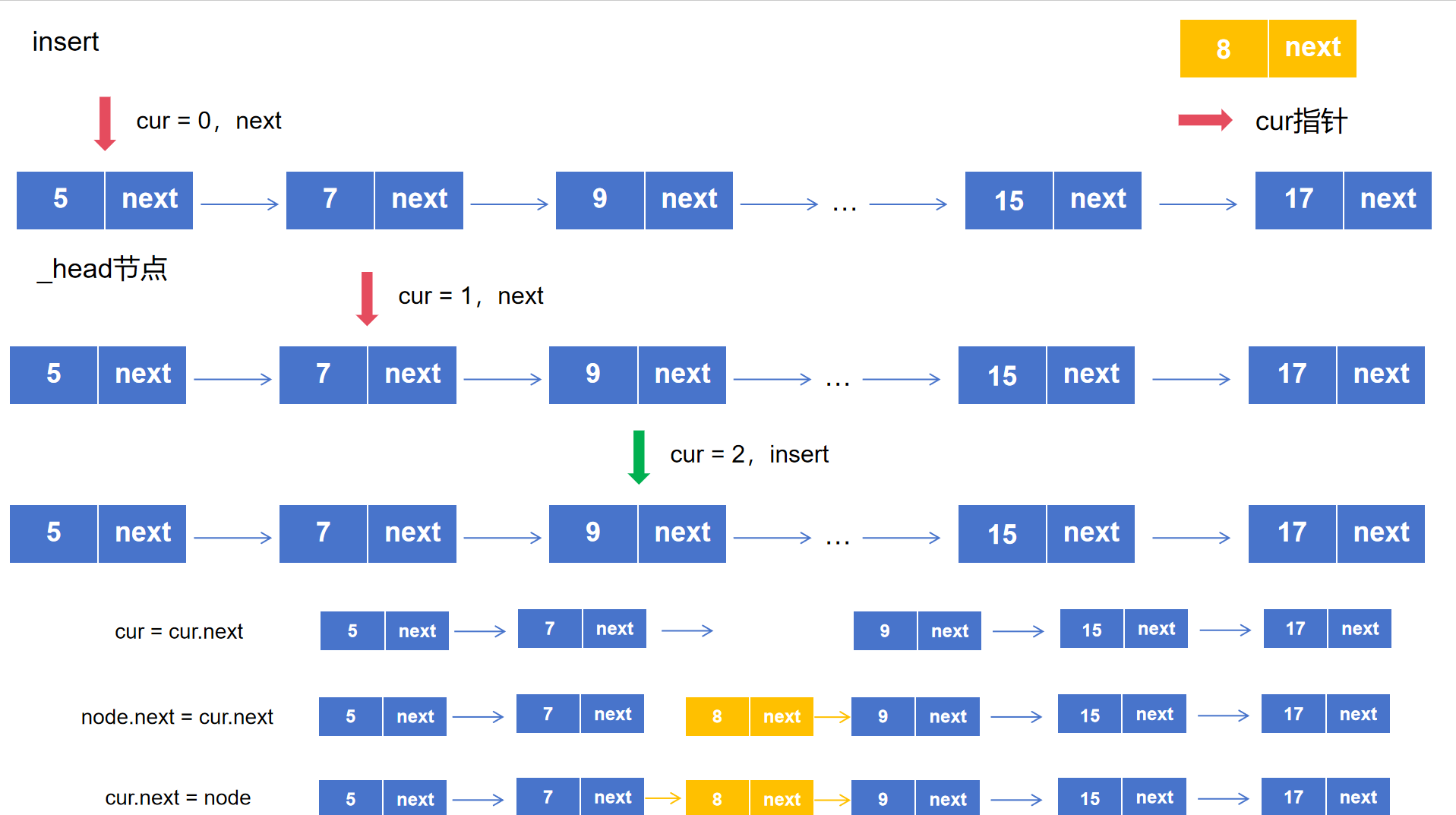
为了保证插入前后,链表其他节点值不变,插入过程中首先断开insert处的节点,插入的新节点先链接后方链表,再连接前方链表
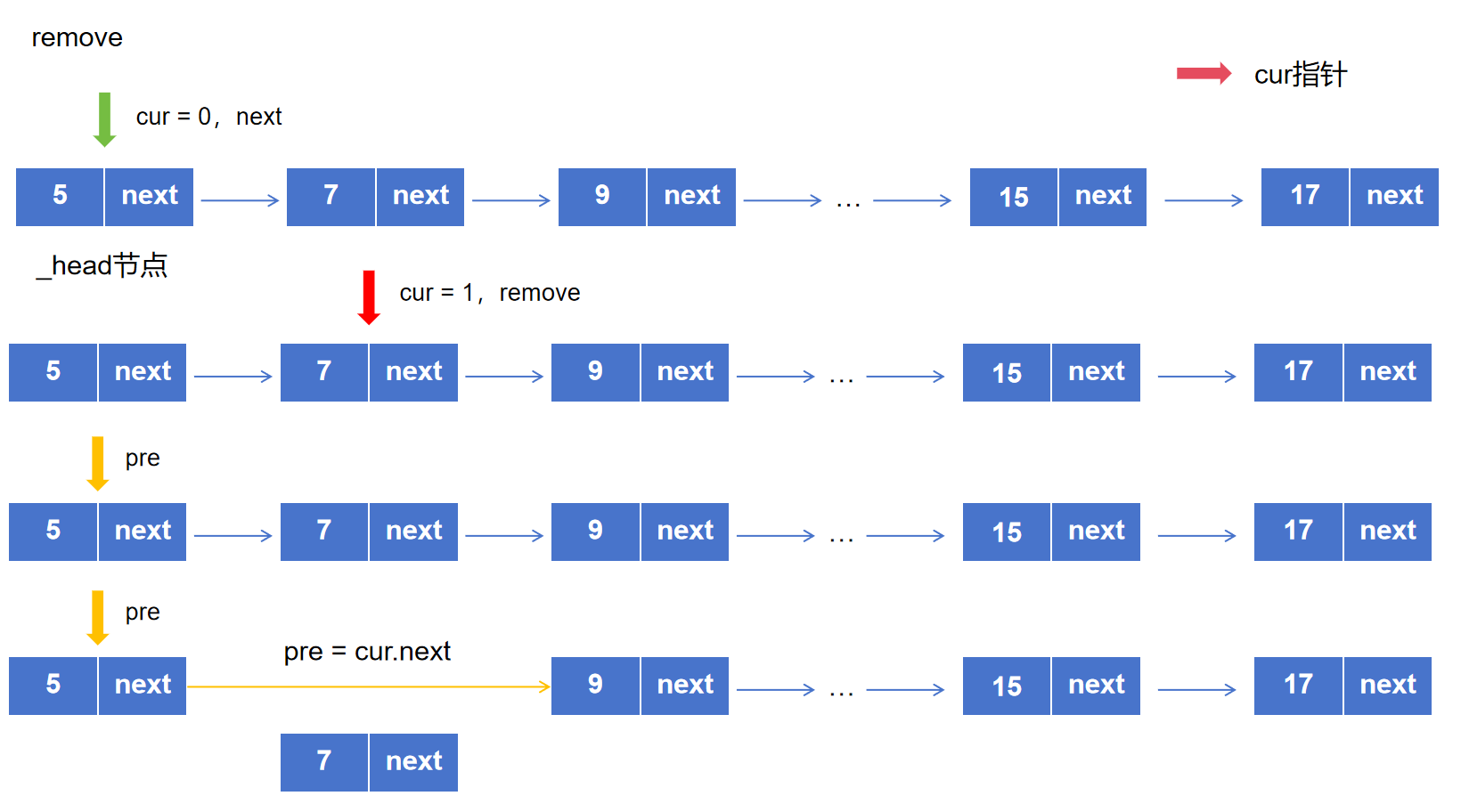
1.3.2 删除指定位置节点#
    def remove(self,val):
        #当前节点和前一节点
        cur = self._head
        pre =  None
        while cur is not None:
            if cur.val == val:
                # 如果删除的节点是第一个节点,既没有前节点
                if not pre:
                    self._head = cur.next
                else:
                    # 将删除位置前一个节点的next指向删除位置的后一个节点
                    pre.next = cur.next
                return True
            else:
                # 两个节点依次向后移
                pre = cur
                cur = cur.next
图解:
1.4 Leetcode实战#
(1)相交链表#
Leetcode题号:160
解法一:#
思路:这个题求的是相交链表,既相交过后两个链表将合并指向一个值,那么相交后最后到达终点经历的的节点数是一样的,判断相交的条件是两个链表第一个相同地址,根据这两个特点,我们可以设计出一条思路:
先让两条链表的起点在距离相交节点相同数量的节点上,既让长的那条链表先移动一定距离,然后两条链表共同向前移动,等到有节点相等时,即为相交链表。
图解:
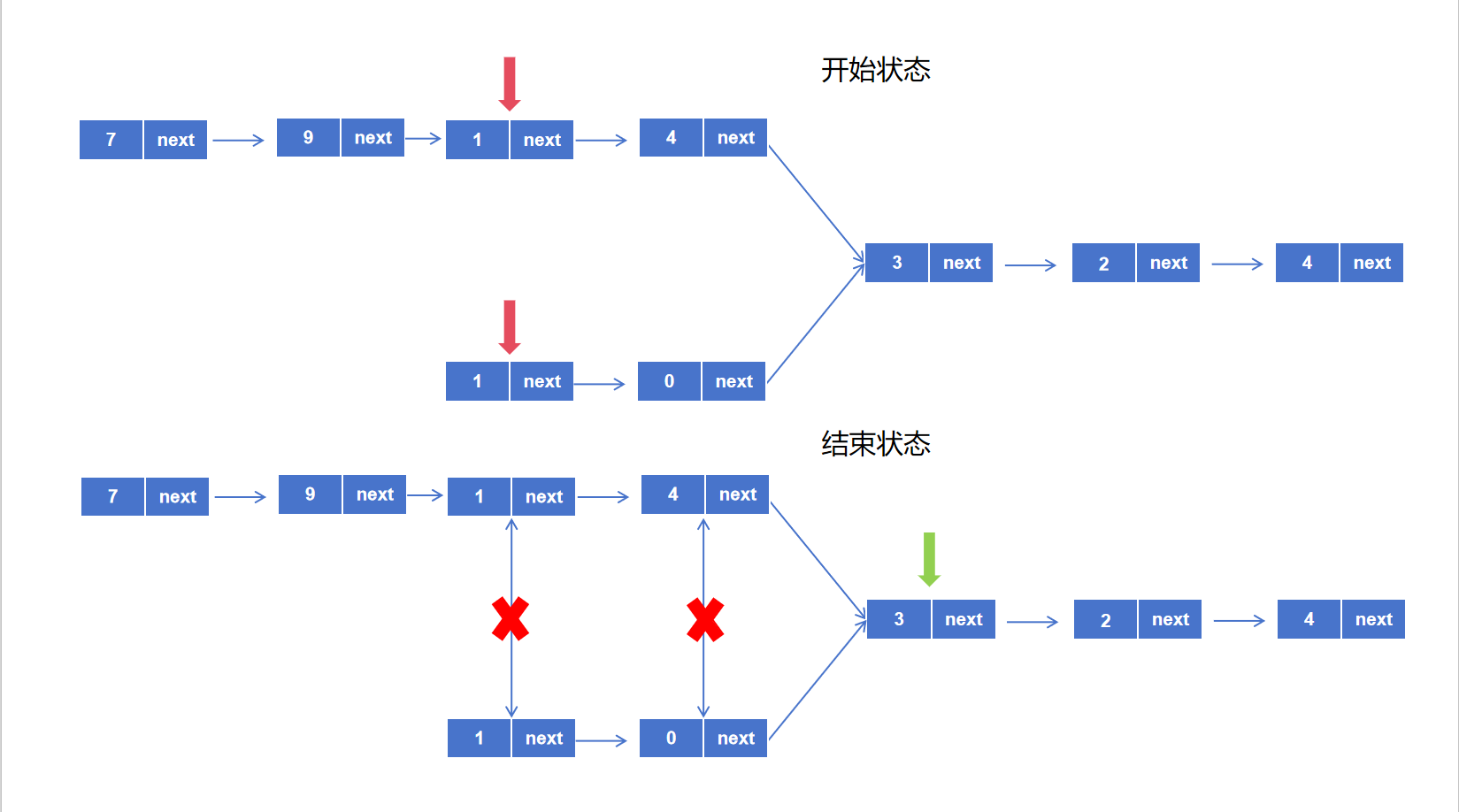
但是要注意一个细节,链表节点判定相等的条件是指向同一个地址,而不是同一个值,因此代码中不是比较val
代码:
class Solution(object):
    def getIntersectionNode(self, headA, headB):
        """
        :type headA, headB: ListNode
        :rtype: ListNode
        """
        def length(head):
            count = 0
            cur = head
            while cur is not None:
                count += 1
                cur = cur.next
            return count

        la = length(headA)
        lb = length(headB)

        cur_a, cur_b = headA, headB

        if lb > la:
            la, lb = lb, la
            cur_a, cur_b = cur_b, cur_a

        gap = la - lb
        while gap != 0:
            cur_a = cur_a.next
            gap -= 1

        while cur_a is not None and cur_b is not None:
            if cur_a == cur_b:
                return cur_a
            cur_a = cur_a.next
            cur_b = cur_b.next

return None解法二:#
图解:
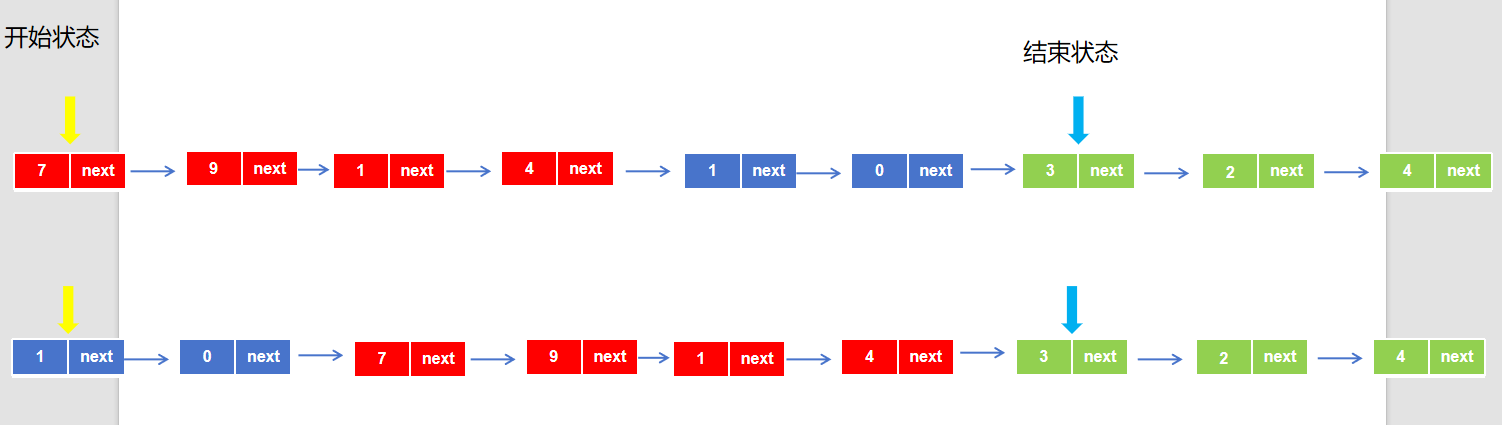
不难看出,解这道题的关键其实就是对齐相交节点,那么我们将第一条链表的所有节点遍历完,再去遍历第二条链表的所有节点,与先二后一所遍历的节点的节点数是一样的,但是在第二次遍历到相同节点时是同时的,这就达到了我们对齐链表的目的,上面图解画的不是很准确,但是基本思想是相同的
class Solution(object):
    def getIntersectionNode(self, headA, headB):
        """
        :type headA, headB: ListNode
        :rtype: ListNode
        """

        def length(head):
            count = 0
            cur = head
            while cur is not None:
                count += 1
                cur = cur.next
            return count
        cur_a = headA
        cur_b = headB
        length_tol = length(headA) + length(headB)
        count = 0
        while count < length_tol:
            if cur_a == cur_b:
                return cur_a
            else:
                count += 1
            if cur_a.next is not None:
                cur_a = cur_a.next
            else:
                cur_a = headB
            if cur_b.next is not None:
                cur_b = cur_b.next
            else:
cur_b = headA(2)反转链表#
Leetcode题号:206
这是一个比较经典的题目,要求将链表反转,既头结点变尾节点,可以抽象的认为反转链表就是反转链表的箭头,这个题主要难点在于理清楚临时变量的作用
图解:
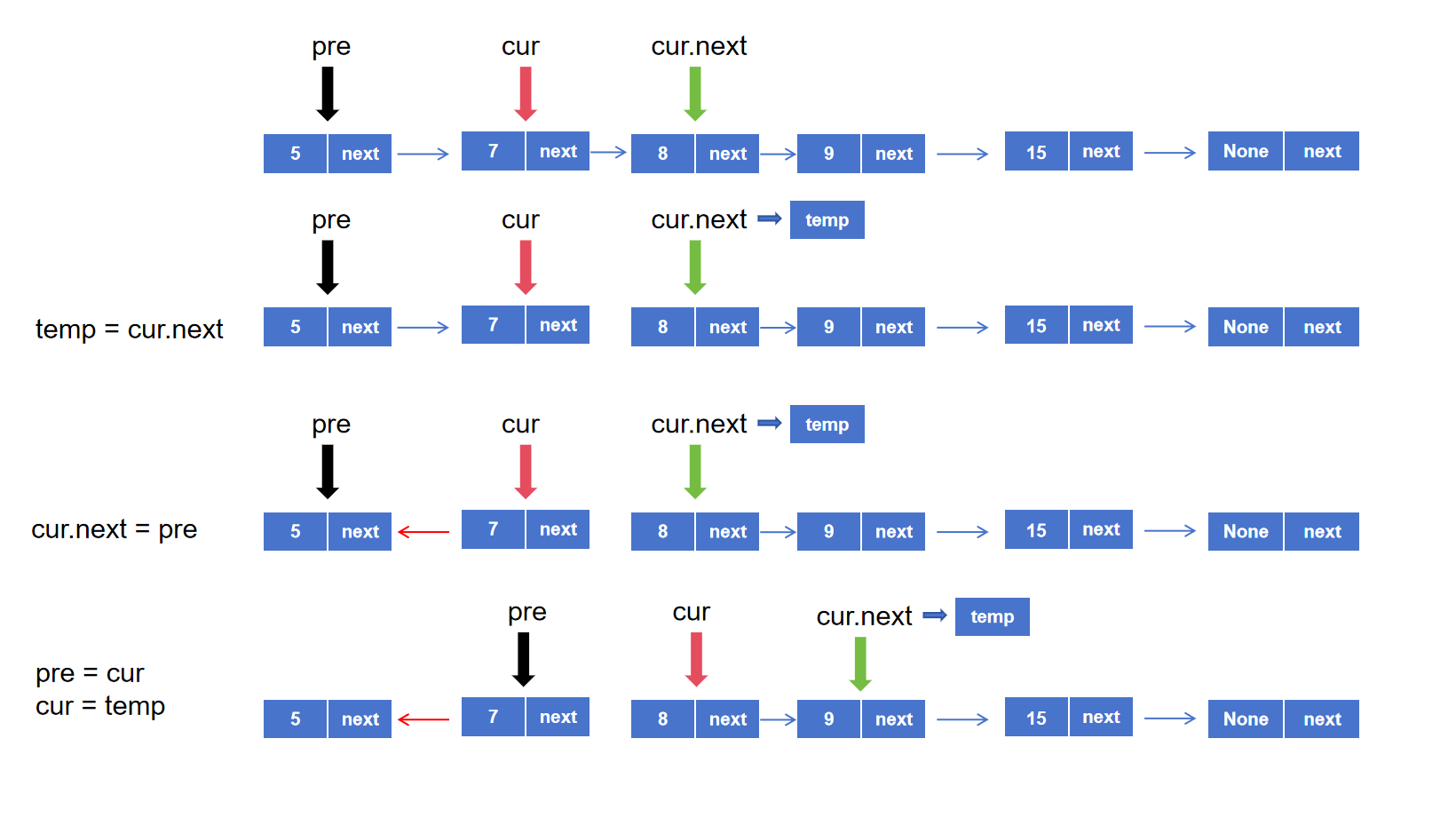
临时变量存储的是cur.next,既cur之后节点的信息,不至于在cur.next = pre的时候丢失 cur.next原本指向的后续节点
代码:
class Solution(object):
    def reverseList(self, head):
        """
        :type head: Optional[ListNode]
        :rtype: Optional[ListNode]
        """
        pre = None
        cur = head
        while cur is not None:
            temp = cur.next
            cur.next = pre
            pre = cur
            cur = temp

        return pre
至于最后为什么返回的是pre,是因为循环停止到最后一个cur节点时,代码仍然执行了pre = cur,cur = temp,也就是指针向后又移了一位,此时cur = None,而pre才是原链表的最后一个节点,既新链表的第一个节点
记录一个题:

number_to_letter = {chr(96 + i): i for i in range(1, 27)}
def fn(str1,str2,number_to_letter):
    steps = []
    length = len(str1)
    for i in range(len(str2[:length])+1):

        # print("---")
        step = 0
        # 第一个循环是取出所有子串
        str2_ = str2[i:i+length]
        if length > len(str2_):
            break
        print(str1,str2_)


        for i in range(len(str1)):
            # 第二个循环是计算每一个子串的距离

            left = str1[i]
            right = str2_[i]
            diff = abs(number_to_letter[left] - number_to_letter[right])
            if diff >= 13:
              diff = 26-diff
            step+=diff
            # print("diff",diff)
        steps.append(step)
        # print("step",step)
    return steps

str1 = "ddhnayalcs"
str2 = "tffivyioexdqifmeadcz"
steps = fn(str1,str2,number_to_letter)
min(steps)